
Quick answer: plan kitchen lighting in layers. Start with task light over the worktops, add lights inside cupboards and drawers that switch on when they open, then add accent light such as plinth and shelf lighting. Finally choose the colour of light and plan how it is powered and controlled. Sensio's 24V lights run from one driver and plug together with no soldering, so a whole kitchen can be planned as one system.
Kitchen lighting plan at a glance
| Zone | What the light does | How it switches on | Sensio options |
|---|---|---|---|
| Worktops under wall units | Task light for preparing food | Wall switch, kinetic switch or app | Under cabinet lights |
| Inside cupboards and larders | Find things easily | Door or PIR sensor | Inside cupboard lights |
| Drawers and pan drawers | Light the contents | IR sensor in the light | Verso drawer light |
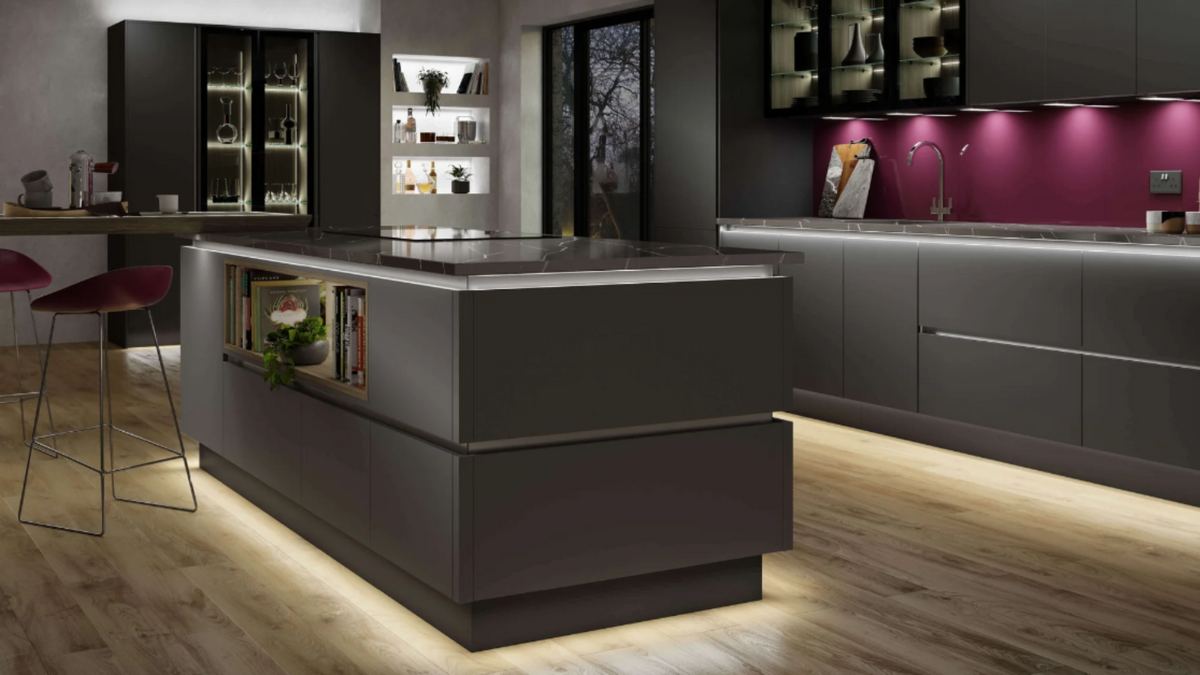
| Plinths and kickboards | Soft glow at floor level | With the room lights or a PIR sensor | Plinth lights |
| Shelves and glass cabinets | Show off what is on display | Switch or door sensor | Shelf lights, display cabinet lights |
| Kitchen island | Light the worktop and the floor round it | Wall switch or app | Island lighting ideas |
Watch: planning lighting into your kitchen design
Step 1: Map the zones
Walk through the kitchen plan and mark every place light is needed: worktops under wall units, the inside of cupboards, larders and drawers, plinths, open shelves and glass cabinets, and the island. Planning lighting at the design stage, before the kitchen is fitted, means cable routes and drivers can be hidden. Read why lighting should be planned from day 1.
Step 2: Task light over the worktops
Task light comes first, because it is where you prepare food. Fit lights under the wall units so they light the front of the worktop without shadows. Spotlights such as Hype TrioTone give pools of light; one or two spotlights per wall unit is a good starting point. LED strip in an LED profile gives a continuous line of light. See how to choose under cabinet lights.

Step 3: Light inside cupboards and drawers
Convenience lighting switches on by itself when a door or drawer opens. Wired lights use a door sensor; drawers use a light with a built-in sensor such as Verso; and cupboards with no power use rechargeable sensor lights. Read our guide to the best lights for inside kitchen cupboards.

Step 4: Add accent light
Accent light adds depth and atmosphere. The most common choices are plinth lighting along the kickboards, lighting above wall units, and shelf lights in open shelving or glass-fronted cabinets. For an island, see kitchen island lighting ideas.

Step 5: Choose the colour of light
Warm white suits wood and traditional kitchens; cooler whites suit modern kitchens and pale stone. If you cannot decide, TrioTone lights give three colours of white in one light. See our colour temperature guide and light colours for kitchen worktops.
Step 6: Plan power and control
Sensio lights run at 24V from an LED driver. Add up the watts of the lights on each driver and use the driver calculator to choose the right size. Then decide how each zone switches on: a wall switch, a sensor, or the Titan Smart Kinetic driver, which works with the Link Sensio app, Alexa, Google Assistant and the wireless kinetic switch.
Kitchen lighting planning checklist
- Every worktop under a wall unit has task light.
- Deep cupboards, larders and drawers light up when opened.
- Plinths, shelves or glass cabinets have accent light where it adds to the design.
- One colour of white is chosen for the whole kitchen, or TrioTone where you want to switch.
- Each driver is sized for the lights on it, with room for the driver to be reached later.
- Cable routes are agreed with the kitchen fitter and electrician before the units go in.
FAQs
What is the first thing to plan in kitchen lighting?
Task light over the worktops, because that is where you prepare food and need the most light.
How many under cabinet spotlights do I need?
One or two spotlights per wall unit is a good starting point. For a continuous line of light, use LED strip in a profile instead.
Do I need an electrician for kitchen lighting?
Sensio 24V lights plug together with no soldering, but the mains supply to the driver should be planned and installed by a qualified electrician, ideally before the kitchen is fitted.
Can I control kitchen lights from my phone?
Yes. The Titan Smart Kinetic driver works with the Link Sensio app, Alexa and Google Assistant.
Every Sensio light is covered by our 7 year guarantee. Shop the full kitchen lighting range or see more kitchen lighting ideas.
More videos: watch the Kitchen lighting video playlist on YouTube, or see all our video guides.