
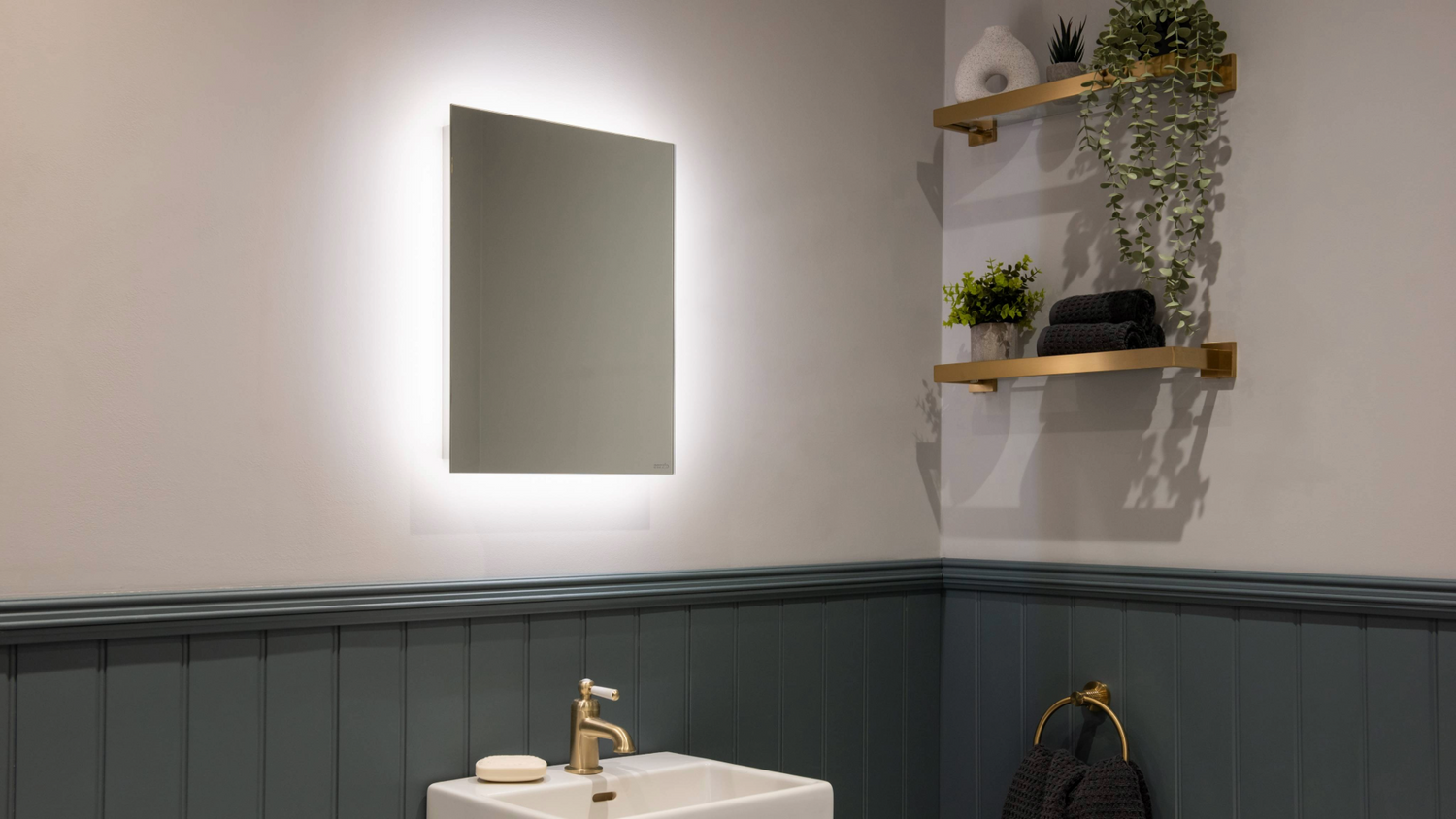
If you want an illuminated mirror where there is no wiring, you have two choices: a mirror that runs on disposable AA batteries, or one with a rechargeable lithium-ion battery. They look similar on the wall. They are very different to live with.
This guide explains the difference, and why we designed and patented our own lithium-ion battery technology for our battery operated LED bathroom mirrors.
What is a battery operated bathroom mirror?
A battery operated bathroom mirror has LED lighting powered by a battery pack behind the glass, rather than by a cable from the mains. Because nothing needs wiring in, it can go on almost any wall: a freshly tiled bathroom, an en-suite with no power at the basin, a rented flat, a caravan or a lodge.
Lithium-ion or AA battery mirror: which is better?
For most bathrooms, lithium-ion. Here is why.
- Charge, don't replace. An AA mirror needs a fresh set of batteries every time they run flat. A lithium-ion mirror is recharged with a USB-C cable, like a phone, and goes back on the wall.
- Lower running cost. Around 7p per charge, compared with up to £5 for a packet of AA batteries, which keep needing to be replaced for the life of the mirror.
- Less waste. One rechargeable pack instead of a steady stream of used AA batteries.
- Light you can rely on. The mirror is designed to give a proper LED mirror's light, not a compromise.
AA mirrors still have a place: they are simple, and spare batteries are easy to buy. We make both, so you can choose. Our AA options are Sierra and Isla Plus.
Why did Sensio design its own battery?
We kept hearing the same two things. Homeowners wanted an illuminated mirror without the wiring, but the only battery mirrors available ran on AA batteries that needed replacing again and again. And fitters told us about the job that was nearly finished: the bathroom tiled, then the customer asks for an illuminated mirror, and there is no wiring in the wall.
So we developed Evo+, a rechargeable lithium-ion battery pack, and patented it. Every Lustro mirror and the Volta mirror cabinet runs on it.
How do you charge a lithium-ion battery mirror?
Lift the mirror off its wall bracket and charge it with the USB-C cable supplied, just as you would charge a phone. When it is charged, hang it back on the bracket. A spare Evo+ battery is also available, so you can swap packs and keep the mirror on the wall.
How long does a battery mirror last on one charge?
A Lustro mirror lasts up to 3 months on a single charge, tested at 1 hour of use a day. A full charge takes 4 to 6 hours by USB-C.
Do I need an electrician to fit one?
No. Lustro and Volta hang on a French cleat bracket fixed to the wall with two screws. There is no mains wiring, so there is no need to chase out walls, run cables or book an electrician. Read more in our guide: can you fit an illuminated mirror without an electrician?
Are battery operated mirrors safe in a bathroom?
Yes. Our Lustro mirrors and Volta cabinet are IP44 rated for use in the bathroom, and because they run from a battery there is no mains supply at the mirror.
Can you replace the battery?
Yes. The Evo+ battery is available as an additional or replacement pack for our lithium-ion mirror range.
The modern choice for installers and designers
For bathroom fitters, a lithium-ion mirror means saying yes to an illuminated mirror at the end of a job, without going back to the electrics. For designers and specifiers, it means a lit mirror can go exactly where it looks best, not where the cable happens to be. See the full range of battery operated LED bathroom mirrors, or read are battery operated bathroom mirrors any good?
More videos: watch the Bathroom lighting video playlist on YouTube, or see all our video guides.